What we do
Five capabilities. One partner who understands regulated environments.
We specialise in regulated industries — but the capabilities we build work for any organisation that values governance, structured outcomes, and practical technology. If accountability matters to your operation, we're a good fit.
The governed voice + actions platform for regulated industries.
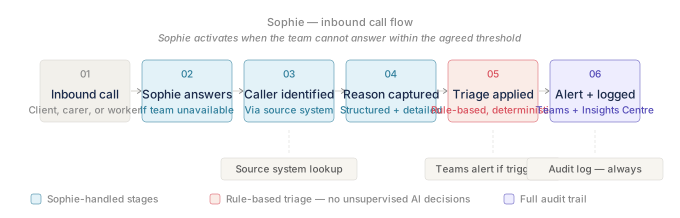
Sophie is Taidotech's managed voice + actions platform. She handles inbound and outbound calls, captures structured data, triggers downstream actions, and gives your team full visibility through the Insights Centre — 24 hours a day, seven days a week.
Sophie is not a voice bot, a telephony solution, or an AI answering service. She is a governed operational platform where voice is the channel, not the product. Deterministic triage, full audit trails, controlled configuration, and SIRS-aware escalation — built for environments where accountability is not optional.
Sophie is delivered as a managed service hosted in Taidotech's Azure tenant in the Azure East Australia region. You don't provision, manage, or maintain infrastructure. From your perspective, Sophie is a service that is always available — not a system that needs to be run.
Sophie is designed to support organisations operating under the Privacy Act 1988, the Aged Care Act 2024, Strengthened Aged Care Quality Standards, NDIS Quality and Safeguards requirements, and APRA CPS 230. Every configuration change follows a controlled process. Sophie does not self-modify in production.
Sophie has her own dedicated platform site with full details on architecture, tiers, pricing, use cases, and the Insights Centre. The link above takes you there.
Inbound and outbound voice, with governed downstream actions
Sophie handles calls, captures structured data, and triggers actions — Teams alerts, CRM updates, AlayaCare lookups, Excel exports — without human intervention on routine interactions.
Full operational visibility, conversation review, and audit trail
Every interaction is logged, transcribed, and reviewable. The Insights Centre surfaces demand patterns, escalation trends, and quality signals — the evidence base for continuous, governed improvement.
Taidotech operates the platform — you use the outcomes
We configure, deploy, monitor, and improve Sophie on your behalf. Governed configuration changes, periodic performance reviews, and targeted recommendations are included in the managed service.
Operational intelligence built from the data you already have.
Most regulated service organisations are sitting on more data than they know what to do with — and less visibility than they need. We connect your systems, surface the signals that matter, and build the analytics layer that turns operational data into evidence-based decision-making.
This isn't AI for AI's sake. We start with the question your operation can't currently answer — why are claims being rejected, where is revenue leaking, which care plans don't match what's being delivered — and build backwards from there. The technology follows the problem.
Our AI + Data work is built on Microsoft Azure — Azure AI services, Azure Machine Learning, and custom integrations connecting the data sources that matter to your operation. We work with AlayaCare, Dynamics 365, SharePoint, and custom system APIs.
Every solution is designed to be interpretable and governable. In regulated environments, a result without a traceable reasoning path isn't useful — and in some cases, it's a liability. We build analytics that can be explained, audited, and defended.
Deliverables range from a single dashboard answering one question, to a full analytics layer connecting multiple systems across an organisation. We scope to the problem, not to a product catalogue.
Capabilities
Revenue leakage analysis
Compare services delivered against services claimed. Surface the gap and identify the patterns — by service type, location, and time period. Built for Support at Home, NDIS, and aged care funding models.
Coding anomaly detection
Flag unusual coding patterns before they become compliance issues. Identify miscodes, duplicates, and outliers across your claims data — with enough lead time to correct, not just report.
Predictive budget modelling
Model future demand, expenditure, and capacity based on historical patterns. Relevant for Support at Home funding management, NDIS budget oversight, and workforce planning across service types.
Care plan vs delivery mismatch
Identify where the care being delivered doesn't match the care plan — supporting both clinical governance and billing accuracy. Flags patterns for review rather than forcing automated corrections.
Quality indicator tracking
Track quality indicators over time, surface trends, and benchmark against targets. Provides the evidence base for quality reporting, continuous improvement, and regulatory submissions.
Data integration layer
Connect disconnected systems into a coherent data layer. We work with AlayaCare, healthcare platforms, Dynamics 365, and custom APIs — building the integration architecture that makes analysis possible.
Dynamics 365 configured for the way regulated services actually work.
Microsoft Dynamics 365 is a powerful platform — but out of the box, it's designed for commercial organisations, not regulated service providers. We configure, deploy, and support D365 solutions that fit your service model: the case management workflows, the compliance requirements, the integration points with sector-specific systems, and the governance controls your auditors expect to see.
We work across D365 Customer Service, D365 Contact Centre, and the broader Power Platform ecosystem. Whether you're replacing a legacy system, standardising across service streams, or building a contact centre from the ground up, we scope and deliver to your operational context — not a generic CRM template.
Our D365 engagements follow the same four-phase methodology as all Taidotech work: discover first, design to fit, deploy with change management, and improve from live data. We don't deliver a system and hand over a manual — we support adoption and refine configuration based on what we learn in production.
D365 is also the integration layer for Sophie in deployments where contact centre and voice automation need to work together. A unified platform means fewer handoffs, better data quality, and a single audit trail across customer interactions — whether they start with a human or with Sophie.
Capabilities
D365 Customer Service
Configuration and deployment of D365 Customer Service for regulated service environments — case management, SLA management, knowledge base, and escalation workflows built to your service model.
Contact centre setup
D365 Contact Centre design, configuration, and optimisation — channel routing, agent desktop, real-time dashboards, and quality management built for high-volume service operations.
Case management and workflow
Custom case management workflows, automated routing rules, SLA escalation logic, and structured resolution paths — designed around your service types and compliance obligations.
System integration
Integration with sector-specific platforms — AlayaCare, clinical systems, HR and rostering tools, finance systems — so D365 reflects your full operational picture, not just what's entered manually.
Power Platform extensions
Power Automate flows, Power Apps portals, and Power BI dashboards extending D365 into adjacent workflows — without custom development overhead or separate licensing complexity.
Training and ongoing support
Role-based training, admin enablement, and ongoing configuration support — so your team can run the system confidently and adapt it as your service model evolves.
Free your people from the work that shouldn't need people.
Regulated service organisations carry an enormous volume of structured, repetitive, compliance-driven work — claims pre-validation, documentation completeness checks, scheduled reporting, rostering notifications, key personnel change records. This work is important. It's also not the highest and best use of your team's expertise and judgement.
We identify the highest-value automation opportunities across your operation and build solutions that run reliably — using UiPath, Power Platform, and Azure automation tools. The goal is not to eliminate roles. It's to redirect your people's capacity towards the work that genuinely requires human skill, empathy, and accountability.
Our automation engagements start with process mapping, not with tooling. We walk the work as it actually happens — not as it's documented — and identify where automation genuinely saves time, where it introduces risk, and where the human needs to stay in the loop. That assessment drives the build, not the other way around.
Every automation solution is governed: version-controlled, monitored, with clear exception handling and human escalation paths for the cases that fall outside the expected pattern. In regulated environments, an automation that fails silently is worse than no automation at all.
Capabilities
Process mapping and assessment
Walk the work as it actually happens. Identify automation candidates, quantify the time impact, assess risk, and prioritise by value — before any build begins. Output: a prioritised automation opportunity register.
UiPath RPA
Robotic Process Automation using UiPath for high-volume, structured, repetitive tasks — claims processing, data entry, system-to-system transfer, scheduled report generation, and compliance documentation.
Power Automate workflows
Low-code workflow automation using Microsoft Power Automate — approval flows, notification triggers, document routing, Teams alerts, and SharePoint integrations for operational and compliance workflows.
Azure Logic Apps integration
System-to-system integration automation using Azure Logic Apps — connecting care management platforms, HR systems, finance tools, and third-party APIs without manual data handling between them.
Claims and compliance automation
Pre-validation of claims before submission, documentation completeness nudges, key personnel change automation, and scheduled compliance reporting — reducing rejection rates and audit exposure.
Monitoring and ongoing support
Automated monitoring of running bots and flows, exception alerting, performance dashboards, and ongoing optimisation — so automations stay reliable as systems and processes evolve around them.
Start with the work. Not with the technology.
The organisations that get the most from AI and automation are the ones that understood their own work before they started automating it. UpliftX is Taidotech's structured advisory framework for doing exactly that — mapping how work actually flows, identifying where AI and automation genuinely fit, and building a prioritised roadmap with a clear evidence base for every investment decision.
UpliftX is the right starting point for organisations that aren't sure where to begin, for those who have tried automation before and found it didn't stick, and for those who want to move deliberately rather than follow a technology trend. It's also the right input to any Taidotech engagement — the discovery that makes everything else land better.
UpliftX is delivered as a structured engagement — typically four to eight weeks — with your operational leaders, team members, and key process owners. We walk the work, not just the org chart. The output is a practical roadmap with prioritised opportunities, effort estimates, and an honest assessment of where AI is genuinely useful and where it isn't.
Where UpliftX leads to a Sophie deployment, a D365 implementation, or an automation programme, the roadmap becomes the brief. Discovery doesn't repeat — it informs the build. For organisations not ready to commit to a full technology programme, UpliftX delivers standalone value: a clear picture of your operation and where the genuine opportunities are.
The UpliftX process
Walk functions as they actually operate — not as they're documented. Identify every task, decision, handoff, and exception path.
Score each identified opportunity against volume, risk, automation suitability, and strategic value. Filter for genuine signal.
Build the business case for each priority opportunity — time saving, cost impact, risk reduction, and quality improvement — with honest assumptions.
Sequence priorities into a phased delivery roadmap with effort estimates, dependency mapping, and a realistic timeline for each phase.
Assess change readiness, identify stakeholder engagement needs, and define the governance model for the programme ahead.
Not sure which capability fits your situation?
Tell us what you're working on. We'll tell you honestly which capability is the right starting point — and where to begin.